Virtual event production has moved from emergency improvisation to a mature discipline with its own tooling, crews and quality standards. The global virtual events market has surpassed 16 billion dollars and is projected to roughly double over the coming years [1]. The vast majority of organisers now see online formats as permanent, and a clear majority treat them as a core part of their event strategy [1]. This guide explains what virtual event production involves, how the workflow is structured, which technologies matter, how to design for engagement, and why the format also carries a markedly lower carbon footprint than its in-person equivalent.
What virtual event production really covers
Virtual event production is the end-to-end process of planning, building and broadcasting an event that audiences attend through a screen rather than a venue. It spans webinars, online conferences, product launches, training sessions and hybrid formats that combine an on-site stage with a remote audience. The discipline borrows directly from broadcast television: a virtual event is, in practice, a live programme that has to be directed, switched, captioned and delivered without interruption.
The difference with a simple video call is production value. A credible virtual event relies on broadcast-quality video, scripted run-of-show, professional audio, on-screen graphics and a dedicated team behind the scenes. Events built with broadcast-quality production retain remote attendees far better than those relying on a basic webcam setup [6]. Teams that understand production management services tend to apply the same rigour online as they would on a physical set.
The production workflow, stage by stage
A virtual event follows the same three phases as any production: pre-production, live execution and post-production. Each phase carries its own deliverables and its own risks.
Pre-production and planning
Pre-production sets the objective, the audience and the format. It covers the run-of-show, speaker briefing, platform selection, graphics package and rehearsal schedule. Strong production partners run comprehensive speaker rehearsals that go well beyond a basic tech check, coaching presenters on virtual delivery and testing every slide transition and video clip before going live [1]. This is also where crews, freelancers and technical resources are scheduled, a step where dedicated crew management software replaces scattered spreadsheets.
Live execution
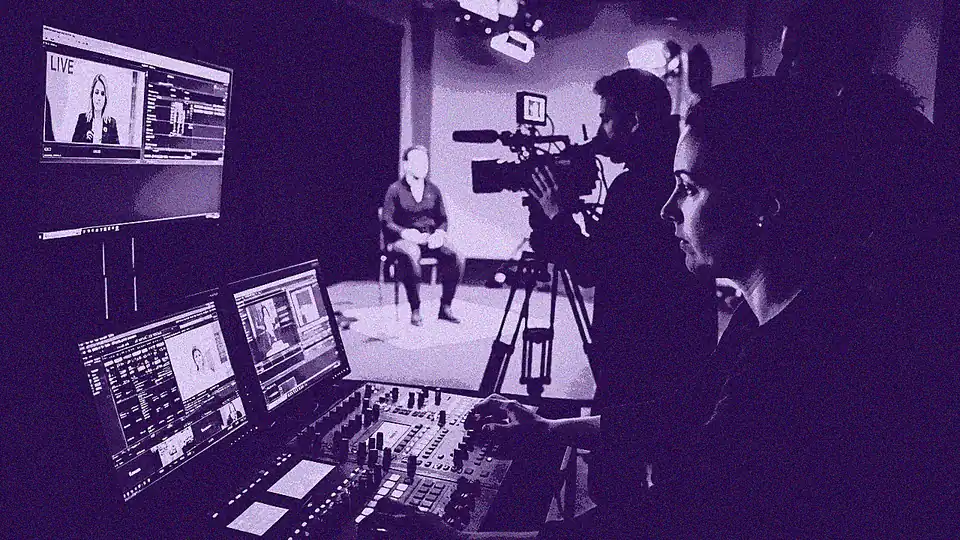
On show day, a director cues speakers, a technical operator switches sources, and a moderator manages chat and questions. Hybrid conferences require dedicated streaming infrastructure, including redundant internet, live switching, backup encoding and remote speaker integration [5]. Redundancy is not a luxury: a single dropped feed during a keynote can undo months of preparation.
Post-production and reuse
After the live broadcast, recordings are edited into on-demand replays and short clips. Salient soundbites, panel highlights and audience reactions are increasingly clipped, captioned, vertically formatted and pushed to social platforms within minutes of happening [5]. This extends the value of a single event across weeks of content.
The technology stack behind a virtual event
Virtual event production rests on layered technology, from capture to delivery. The table below summarises the main components and what each contributes.
| Layer | Role | Typical tools |
|---|---|---|
| Capture | Cameras, microphones, lighting for speakers | Multi-camera rigs, lavalier and shotgun mics |
| Switching | Mixing sources, graphics and transitions live | Hardware or software vision mixers |
| Encoding | Compressing the signal for streaming | Hardware encoders with backup units |
| Platform | Hosting the audience experience | Virtual event platforms with chat and polls |
| Engagement | Polls, Q&A, breakout rooms, networking | Interactive overlays and apps |
| Analytics | Measuring attendance and behaviour | Dashboards and lead tracking |
Artificial intelligence has become part of this stack. Around half of meeting planners now use AI tools for scheduling, matchmaking and content creation [6], and AI-powered platforms are associated with significantly higher attendee satisfaction [2]. Immersive features such as virtual and augmented reality are shifting from optional extras to baseline expectations for premium formats.
Designing for engagement
The hardest problem in virtual event production is attention. A remote audience can leave with a single click, so engagement has to be designed into the run-of-show rather than added afterwards. Engagement drops sharply when a format stays passive for more than roughly a quarter of an hour at a stretch, which is why every session should include at least one interactive moment: a live poll, a chat prompt or a direct question to the audience [1].
The data backs this up. A large majority of virtual attendees take part in interactive elements such as polls and live Q&A, and most organisers now use live polling as a core retention tool [2]. Hybrid formats built around AI-driven polls and apps reach engagement rates well above those of traditional formats, and they convert leads at a noticeably higher rate [5]. The principle is consistent: virtual events should be designed around the attendee, not the agenda.
The environmental case for going virtual
Beyond cost and reach, virtual event production carries a strong environmental argument. Fully digital events have footprints many times smaller than their in-person equivalents because they eliminate travel and venue energy [3]. Studies analysing the shift from physical to online formats describe substantial reductions in both event carbon footprint and energy use, on the order of around ninety percent [4].
Virtual is not carbon-neutral, however. Online events still generate emissions through participant devices, data transfer across networks, cloud servers and pre-event coordination calls. In one analysed conference, the majority of emissions came from network data transfer, with a meaningful share attributed to planning meetings and computer use during the event itself [4]. Measuring that residual footprint is the natural next step for organisers who want credible claims, an area covered in TheGreenshot guide to the administrative side of production and in its broader sustainability resources.
Virtual event production for AV teams and event organisers
For audiovisual producers and live event organisers, virtual production is rarely a standalone activity. It sits alongside physical shoots and on-site events, mobilising the same crews, suppliers and logistics. A festival that adds a streamed stage, a corporate event with a remote audience or a product launch broadcast from a studio all rely on coordinated technical teams working over very short windows.
Live events and festivals
When an organiser streams part of a festival or conference, the production crew expands to cover capture, switching and moderation in parallel with the on-site operation. The bottleneck is rarely the technology: it is the coordination of freelancers, technicians and equipment across overlapping setup and show windows. Scheduling these resources by email and spreadsheet quickly breaks down once a hybrid layer is added.
Film, TV and branded content
Studios producing branded virtual events apply the same discipline as a shoot: call sheets, departmental briefs and tight turnaround on edits. The supply chain of cameras, lighting, sound and post-production is identical, which is why teams used to crew scheduling for film and TV adapt naturally to virtual formats. Budgeting also matters, and the same logic that drives a sound AV budget applies to a virtual production line.
Going further with TheGreenshot
Producing a virtual or hybrid event means coordinating technicians, freelancers and equipment across compressed timelines, often while a physical operation runs in parallel. Ooviiz centralises that coordination for audiovisual and event teams, replacing scattered spreadsheets and informal messages with a single platform for scheduling crews, managing technical resources and keeping everyone aligned in real time. Built specifically for the audiovisual, events and entertainment industries, it brings online schedules, a centralised talent base, a team communication app and contract e-signatures into one workflow. For organisers juggling on-site and remote production at the same time, that shared source of truth removes the friction that usually appears the moment a hybrid layer is added. Exploring how a dedicated coordination platform fits an existing production process is a practical first step.
FAQ
What is virtual event production?
How is a virtual event different from a video call?
Are virtual events better for the environment?
How can organisers keep a virtual audience engaged?
What technology is needed to produce a virtual event?
Our carbon experts help production studios frame strategy, train teams and track results, tailored to operational constraints.