Live events run on freelancers. Effective freelance crew management for live events means contracting and coordinating temporary workers who fill essential production tasks, from riggers and audio techs to camera operators and stagehands [2]. Crew management software, also called freelance management software, exists precisely because event production companies depend on this rotating workforce [2]. This article explains what freelance crew management involves, the workflow it follows, and the features that keep a freelance-heavy operation coordinated from first booking to final payment.
What freelance crew management means for live events
Freelance crew management is the practice of sourcing, booking, scheduling, communicating with, and paying a temporary workforce assembled for each event. Because the same people are rarely available for every job, the discipline centres on maintaining a reliable talent pool and matching the right person to the right role at the right time [3]. Storing rates, contact information, skills, and contracts in one place makes crew easy to find when scheduling [2].
The stakes are operational. A single view of open positions and crew availability lets a coordinator fill jobs and handle last-minute changes without cross-referencing scattered documents [2]. Teams new to the category often benchmark it against an event staffing management platform and against crew scheduling software for film and TV, which share the same core logic.
The workflow: from booking to payment
A mature freelance crew workflow moves through connected stages, each of which a dedicated platform automates.
Sourcing and booking
Coordinators assign roles from a maintained talent pool, checking availability and skills before confirming [3]. The strongest systems let a manager book crew and then immediately book their travel without re-entering the same information repeatedly [1].
Contracts and confirmation
The most advanced platforms connect scheduling data directly to contract generation. When a crew member is booked through the scheduling module, a contract can be automatically drafted and sent for electronic signature [2], turning a verbal hold into a documented commitment.
Communication during the event
Crew management software enables clear communication with every member of the crew as a team prepares for and then produces a live event [3]. Mobile communication keeps everyone aligned when call times move or roles shift on site.
Payment and reporting
The final stage links confirmed hours to payment. End-to-end platforms simplify everything from recruiting, scheduling, and contracting through to payments and tax reporting, with budgets and policies set per event [4]. Talent databases that schedule shifts, track check-in and check-out, and manage payroll close the loop [5].
Features that define effective crew management software
Not every scheduling tool handles freelance crews well. A capable platform covers a consistent feature set built around the realities of temporary labour.
| Feature | What it does | Why freelance crews need it |
|---|---|---|
| Talent database | Stores rates, skills, contacts, contracts | Makes the right crew easy to find when booking [2] |
| Availability view | One view of open roles and who is free | Fills jobs and absorbs changes fast [2] |
| Contract automation | Drafts and sends for e-signature on booking | Documents commitments instantly [2] |
| Linked travel | Books travel without re-entering data | Removes duplicate admin for touring crews [1] |
| Mobile communication | Real-time messaging and updates | Keeps crew aligned when plans shift [3] |
| Payments and reporting | Handles pay and tax reporting per event | Closes the loop from hours to payout [4] |
Evaluating these features against real workflows matters more than counting them. A platform that mirrors a solid production scheduling approach for live events will hold up where a generic calendar tool does not, and it aligns naturally with a broader film production management platform when crews cross between events and screen work.
Handling last-minute change without losing control
Live events change constantly, and freelance crews amplify that volatility because availability is never guaranteed. The defence is a single, current view: one place showing all open positions and crew availability so a coordinator can react rather than reconstruct [2]. When booking, contracts, and travel are linked, a swap does not mean re-entering data in three systems [1]. Real-time communication then confirms the change with the crew immediately [3]. The alternative, spreadsheets and messaging apps, works at small scale but breaks down quickly as event volume rises [5].
Freelance crews in live events and productions
Freelance crew management shows up wherever specialised, temporary labour is assembled fast, and the pattern repeats across live events and screen productions.
Live events and venues
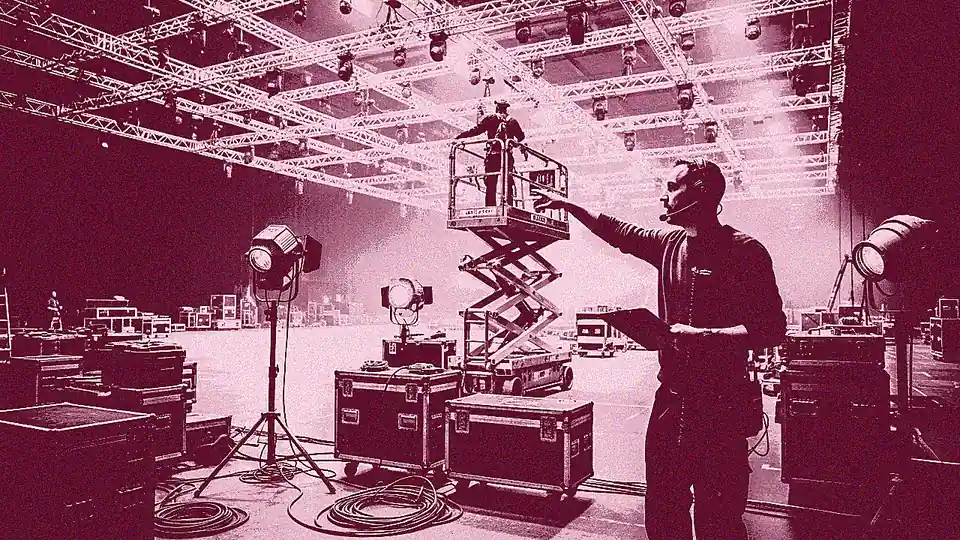
Festivals, concerts, and corporate events depend on freelancers who must be booked, briefed, and paid on compressed timelines [3]. Platforms built for live event organisations let teams crew an event and immediately handle the travel and logistics that follow [1]. Native mobile messaging is decisive when a rig runs late or a section is short a technician an hour before doors [3].
Screen productions
Film and television productions run on the same freelance model, drawing department crews per project and coordinating them against a shifting schedule. Linking booking to contracts and payroll is exactly what freelance-heavy shoots need, and it connects directly to how call sheet software distributes the daily plan to the crew on set.
Ooviiz centralises planning and crew coordination for productions and events, replacing spreadsheets and informal messaging with a dedicated platform. Discover Ooviiz
Conclusion
Freelance crew management for live events is the connective tissue of temporary production labour: sourcing, booking, contracting, communicating, and paying a workforce that reassembles for every job. The teams that do it well replace spreadsheets and group chats with a dedicated platform that holds a talent database, availability, contracts, communication, and payments in one linked system [2]. As freelance labour becomes the default across events and productions, that consolidation is what lets organisers scale without drowning in coordination, and it is where reliable delivery begins.
FAQ
What is freelance crew management for live events?
What does crew management software do?
How does crew management software handle contracts?
Why not manage freelance crew with spreadsheets?
Does freelance crew management apply to film as well as events?
Going further with TheGreenshot
Freelance crew management for live events comes down to one thing: keeping a rotating, temporary workforce coordinated from booking to payment as plans change. Ooviiz, the crew planning tool from TheGreenshot, was built for this reality. It centralises a talent database with rates, skills, and contracts, gives coordinators a real-time view of availability and open roles, and lets crews manage availability and accept missions from a mobile app. Booking flows straight into electronic contract signature and clean payroll exports, so a confirmed shift becomes a documented, payable commitment without duplicate admin. For event and production teams that live on freelancers, replacing spreadsheets with a dedicated platform is what makes scaling manageable. A short walkthrough shows how it fits an existing workflow.
Our carbon experts help production studios frame strategy, train teams and track results, tailored to operational constraints.