Virtual production is one of the most significant shifts in filmmaking methodology in decades. By replacing physical locations and green screen stages with real-time rendered LED environments, it allows directors, cinematographers, and actors to see and interact with digital worlds as they shoot. The global virtual production market is valued at over USD 2 billion and is growing at more than 30% annually [1], driven by falling LED panel costs, rising adoption of real-time rendering engines, and growing demand for immersive content across film, TV, and streaming platforms. This article explains what virtual production is, how LED volumes function, what the production workflow looks like, and which tools define the field.
What is virtual production?
Virtual production is an umbrella term covering a set of filmmaking techniques that use digital technology to integrate live-action performance with computer-generated environments in real time, on set, during principal photography. It is not a single technology but a methodology that brings together game engine rendering, LED display systems, camera tracking, and previsualization into a unified on-set workflow.
The defining characteristic of virtual production is that the digital environment is visible and reactive during shooting. This contrasts with traditional visual effects workflows, where actors perform against green screen and the background is added in post-production months later. In a virtual production stage, the LED panels display a photorealistic environment that responds to camera movement in real time, providing natural reflections on props and actors, accurate lighting from the virtual environment, and an immersive context that shapes performance.
Virtual production encompasses several related techniques: LED volume stages (in-camera VFX), extended reality (XR) stages, motion capture, performance capture, and real-time previsualization. The LED volume is the most visible and widely adopted form, made famous by productions such as The Mandalorian, which pioneered the approach for episodic television. TheGreenShot’s production management platform supports the logistical coordination required to manage virtual production crews and multi-department workflows.
How LED volumes work
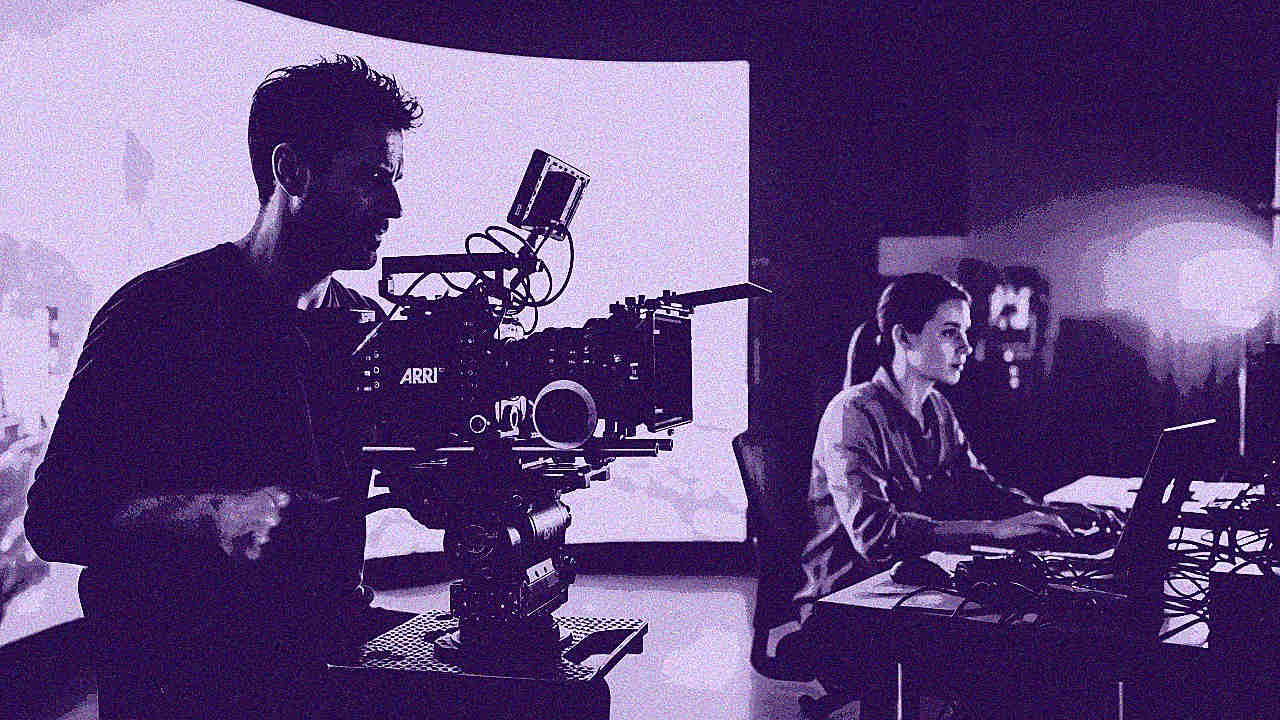
An LED volume is a large-scale display structure built from high-resolution modular LED panels, typically arranged in a curved or cylindrical configuration to surround the filming area. The panels display computer-generated imagery rendered in real time by a game engine, most commonly Unreal Engine [2].
A camera tracking system monitors the exact position and orientation of the camera at all times, feeding this data to the rendering engine. As the camera moves, the perspective of the virtual environment displayed on the LED wall shifts accordingly, creating a parallax-accurate background that behaves as a real physical environment would. To the camera lens, the digital background appears photorealistic and correctly integrated with the foreground action.
The LED panels also function as a physical light source. Because the background emits real light, actors and objects on set are lit by the virtual environment, creating genuine reflections in glass, metal, and eyes that would be impossible to replicate in post-production. This dramatically reduces the need for separate physical lighting rigs to simulate environmental light.
LED volumes vary significantly in size and configuration, from small single-panel XR stages used for broadcast production to massive curved structures spanning hundreds of square metres built for major film productions. Panel resolution, refresh rate, and colour accuracy are critical specifications that determine how the volume performs under high-resolution cinema cameras.
The virtual production workflow
Virtual production requires a substantially different workflow from traditional filmmaking. The process begins significantly earlier in pre-production and requires closer collaboration between departments that typically operate sequentially in conventional productions.
Pre-production and previsualization
The virtual production workflow starts with the creation of digital environments in pre-production, often months before principal photography begins. These environments must be modelled, textured, lit, and optimised for real-time rendering before the shoot. Previsualization (previs) and technical visualization (techvis) sessions allow directors and directors of photography to plan shots, test camera moves, and adjust the digital environment before committing to on-set time [3].
On-set virtual production
During principal photography, the real-time rendering team operates the game engine to display and adjust the virtual environment on the LED wall. Camera tracking data is fed live into the system to maintain perspective accuracy. The director of photography can adjust lighting parameters in the virtual environment from the set, affecting both the displayed background and the physical light emitted by the panels. This collaborative, real-time approach compresses the feedback loop between creative decisions and their visual result.
Post-production integration
For sequences shot with in-camera VFX on an LED volume, a significant proportion of the visual effects work is complete at the end of the shoot day. Some productions use hybrid approaches, combining LED volume backgrounds with a narrow green screen band for elements added in post. Final colour grading, sound design, and any residual VFX work are completed in post-production, though the volume and complexity of post-production VFX work is substantially reduced compared to conventional green screen shoots [4].
Key tools and technologies
Several core technologies underpin virtual production workflows.
Unreal Engine
Epic Games’ Unreal Engine has become the industry standard for real-time rendering in virtual production. Its nDisplay plugin is specifically designed for multi-screen LED volume configurations, supporting camera tracking integration and stage-specific calibration. Unreal Engine is free to use and has a substantial ecosystem of plugins, assets, and technical support for virtual production applications.
Camera tracking systems
Camera tracking is one of the most technically demanding components of a VP workflow. Several technologies are used depending on the production context: optical tracking (infrared markers), encoder-based systems on camera heads and dollies, and inertial measurement units. The tracking system must deliver sub-millimetre accuracy at the speed of live shooting to maintain the illusion of parallax-accurate perspective on the LED wall.
LED panel technology
The quality of the LED panels determines the credibility of the virtual environment to the camera. Key specifications include pixel pitch (the distance between LED elements, which determines minimum shooting distance), peak brightness (measured in nits), colour gamut coverage, and refresh rate. For cinema cameras with high frame rates and rolling shutters, panel refresh rates must be high enough to avoid moire and scan line artefacts [5].
Production management platforms
The operational complexity of a virtual production requires robust crew coordination tools. VP shoots involve highly specialised roles, including real-time technicians, LED technicians, tracking operators, and previs artists, who must be scheduled alongside the conventional film crew. Ooviiz centralises crew scheduling and coordination for productions with multi-department and multi-speciality crew pools, supporting the logistics of both conventional and virtual production projects.
Advantages and challenges of virtual production
Advantages
Virtual production offers several concrete operational and creative advantages over conventional location shooting and green screen techniques. Productions using LED volume stages report reductions in travel and location costs, as entire environments can be recreated on stage without moving cast and crew to remote locations. Field studies have documented reductions in greenhouse gas emissions of 20% to 50% when productions switch from physical location shooting to LED stage environments [6], driven by elimination of long-haul travel, reduced freight, and lower overtime from unpredictable location conditions.
Creative advantages include the ability to shoot day-for-night or in any weather condition without dependency on real-world conditions, the ability to modify environments instantly between shots, and the immersive context provided to actors who can see and react to their environment in real time rather than imagining it against a green screen.
Challenges
Virtual production is not without significant challenges. The upfront investment in LED panels, tracking hardware, and real-time rendering infrastructure is substantial. A shortage of experienced LED volume operators and real-time technicians creates staffing bottlenecks on productions seeking to adopt the approach [7]. Digital environments must be production-ready before the shoot begins, which shifts creative workload into pre-production and requires clear processes for managing last-minute creative changes.
Productions must also address colour calibration carefully: the virtual environment on the LED wall must be colour-calibrated to match the camera’s colour science, or the in-camera background will look disconnected from the foreground. This requires close collaboration between the director of photography, the LED technician, and the real-time rendering team throughout the shoot.
Virtual production in film, TV, and live events
Virtual production has moved well beyond experimental use to become a mainstream technique across film, television, and, increasingly, live events and corporate production.
Film and TV
Feature films and high-end drama series represent the largest adopters of LED volume technology. The technique is particularly well-suited to science fiction, fantasy, and period productions that require extensive location or environment creation. Large studios across North America and Europe have invested in permanent LED volume infrastructure, and a growing number of purpose-built virtual production studios are available for hire.
For episodic TV, virtual production offers schedule predictability that location shooting cannot. Weather delays, permit issues, and travel time between locations are eliminated for sequences shot on the LED stage. Production managers report that LED volume shooting days can be scheduled with greater precision than location days, reducing overtime and improving crew welfare. On productions managed through Ooviiz, the scheduling module accommodates the specialised crew categories required for virtual production shoots alongside conventional film departments.
Live events and corporate production
Virtual production techniques are increasingly used in live event contexts, particularly for broadcast-linked concerts, awards shows, and brand activations. XR stages, a variant of the LED volume approach designed for live broadcast, allow performers or presenters to appear in real-time digital environments during live transmission. This technique reduces the need for elaborate physical set construction and allows environments to change instantaneously between segments.
Corporate video and advertising production has adopted virtual production workflows at scale, particularly for product visualisation and brand campaign content. The ability to place products or presenters in any environment without travel costs or location fees makes LED volume production attractive for high-volume commercial content. A number of production companies specialising in this segment have established permanent XR stages specifically for advertising and corporate use.
Ooviiz centralises the planning and coordination of teams for productions and events, replacing spreadsheets and informal exchanges with a dedicated platform. Discover Ooviiz
Conclusion
Virtual production has established itself as a fundamental technique in contemporary film and TV production, offering creative flexibility, schedule predictability, and measurable environmental benefits compared to conventional location shooting. LED volumes, real-time game engines, and sophisticated camera tracking systems have created a new category of production infrastructure that continues to expand rapidly. As panel costs fall and the pool of trained technical specialists grows, virtual production will become accessible to a broader range of productions. For production teams, understanding the workflow, tools, and coordination requirements of virtual production is increasingly essential to competitive operation in the audiovisual industry.
FAQ
What is virtual production in film and TV?
What is an LED volume in virtual production?
What software is used in virtual production?
What are the environmental benefits of virtual production?
What is the difference between virtual production and green screen?
Go further with TheGreenShot
Virtual production shoots involve a wider range of specialised crew categories than conventional film sets: real-time technicians, LED operators, tracking specialists, and previs artists must be coordinated alongside the traditional departments of camera, lighting, sound, and art. Managing this complexity requires more than a spreadsheet. Ooviiz, TheGreenShot’s crew planning platform, provides a centralised database for all crew categories, with availability management, mission offers, real-time scheduling, and e-signature contract workflows in a single interface. Whether coordinating a full LED volume shoot or a hybrid virtual and location production, Ooviiz allows production managers to maintain visibility across all departments without the fragmentation of multiple tools and informal channels. A dedicated walkthrough is available for production teams exploring the platform.
Our carbon experts help production studios frame strategy, train teams and track results, tailored to operational constraints.