
Clean energy technologies now attract twice as much capital as oil, gas and coal combined, a split that would have seemed unthinkable a decade ago [1]. Green technology, the broad family of tools, materials and processes designed to cut emissions and resource use, has moved from the margins of climate policy to the centre of industrial strategy. This article explains what green technology covers, which innovations are maturing fastest, where the money is flowing, and what the shift means for sectors such as audiovisual production and live events that are rethinking how they operate.
Open the calculator ↓
What green technology means today
Green technology, sometimes called cleantech or climate tech, refers to any technology whose primary purpose is to reduce environmental harm: lower greenhouse gas emissions, cut energy and water consumption, limit waste, or restore ecosystems. The category spans hardware and software alike, from solar panels and heat pumps to carbon accounting platforms and smart grid controls. What unites them is a measurable environmental benefit rather than a single industry.
The field has broadened considerably. Early green technology was dominated by renewable electricity generation, but the definition now includes energy storage, electrified transport, low carbon materials, circular manufacturing, precision agriculture and the digital tools that measure and manage all of the above [3]. Analysts increasingly treat green technology as a general purpose capability, comparable to digitalisation, that reshapes how every sector produces and consumes. For organisations trying to understand their starting point, a clear GHG Protocol framework is often the first step before any technology is selected.
The technologies driving the transition
Several clusters of green technology are maturing at once, and their combined effect is larger than any single breakthrough.
Renewable generation and storage
Solar photovoltaics have become the single largest line item in global energy investment, drawing roughly 450 billion dollars in a single year [1]. Battery storage, long seen as the missing piece of a renewable grid, now attracts around 65 billion dollars annually and is falling steadily in cost [1]. Together they allow variable sources such as wind and solar to supply firm, dispatchable power. Renewable capacity additions have reached record levels, with solar accounting for the bulk of new installations worldwide [2].
Grids, efficiency and electrification
Modernising electricity networks is now a priority in its own right, with grid investment running at about 400 billion dollars a year [1]. Smart grids, demand response and digital metering let operators balance distributed renewable supply with demand in real time. Electrification of transport and heating, paired with efficiency gains in buildings and industry, extends these benefits across the economy.
Digital and measurement tools
A quieter but decisive strand of green technology is software. Carbon accounting platforms, life cycle assessment tools and AI driven monitoring turn sustainability from an annual report into an operational discipline. The ability to measure emissions accurately is what makes reduction targets credible, which is why choosing the right sustainability software has become a strategic decision rather than a back office formality.
Investment, momentum and market signals
The clearest signal that green technology has entered the mainstream is capital allocation. Total global energy investment is set to reach a record 3.3 trillion dollars, of which 2.2 trillion flows to clean energy technologies [1]. Electricity related investment is now roughly 50 percent higher than the amount spent bringing oil, gas and coal to market, reversing the balance of a decade ago [1]. Industry analysts expect the broader green technology and sustainability market to keep expanding at a double digit annual rate as renewable adoption and smart infrastructure spread [3].
Geography matters too. A handful of large economies now account for the majority of clean energy spending, with one country alone representing close to a third of the global total [1]. This concentration shapes supply chains for panels, batteries and critical minerals, and influences the pace at which green technology reaches smaller markets and sectors. Companies that want to understand their own exposure often begin by mapping their avoided and value chain emissions before committing to specific technologies.
Barriers that still slow adoption
Momentum does not mean the transition is frictionless. Upfront capital costs remain a barrier for smaller organisations, even where green technology is cheaper over its lifetime. Grid connection queues, permitting delays and shortages of skilled installers constrain how fast new capacity can come online. Supply chains for batteries and critical minerals are concentrated and exposed to geopolitical risk.
There is also a credibility challenge. As green claims multiply, so does scrutiny, and poorly substantiated marketing invites accusations of greenwashing. The practical response is measurement: organisations that can document real reductions with verifiable data are far better placed than those relying on narrative alone. Expert guidance, such as the support offered through a dedicated green strategy service, helps translate ambition into an auditable plan rather than a communications exercise.
What green technology changes for productions and events
Audiovisual production and live events are a revealing test case, because they combine energy, transport, equipment and waste in short, intense bursts. Green technology is reshaping each of these areas in concrete ways, and the sector has its own reference frameworks such as Albert and Ecoprod to guide adoption.
On film and television sets
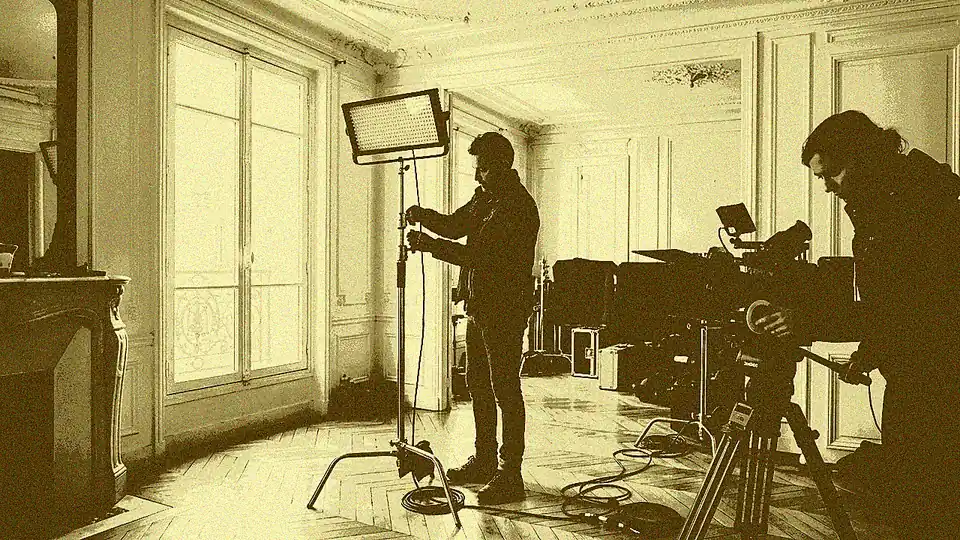
Lighting is the most visible change. Energy efficient LED fixtures draw a fraction of the power of traditional tungsten units and generate far less heat, reducing both electricity use and cooling needs on set. Mobile battery systems are increasingly replacing diesel generators for location shoots, cutting on site emissions and noise. Virtual production stages, where LED volumes replace location travel, can shrink the transport footprint of a shoot when used deliberately rather than as a novelty. Measuring these gains across a production remains the hard part, which is where a studio level view of its carbon footprint becomes essential.
At live events
Festivals, concerts and corporate events face the same equation at larger scale: temporary power, audience and crew mobility, local suppliers and waste. Grid connections and battery hybrids are steadily displacing standalone generators, while event organisers use digital tools to track energy, travel and procurement against recognised standards such as ISO 20121. The common thread with productions is that technology only delivers once its impact is measured and compared.
Measuring the impact with GreenPro
GreenPro, the carbon tracking tool from TheGreenshot, automates data collection for productions and events: footprints that are consistent with Albert, CSRD and the GHG Protocol, without manual spreadsheets. Learn more about GreenPro.
Estimate your company’s carbon footprint
Turning these principles into a concrete figure is the quickest way to see where a company’s emissions sit. The free TheGreenshot calculator below estimates a company’s annual footprint across scopes 1, 2 and 3, using official ADEME and EPA emission factors.
Conclusion
Green technology has crossed the threshold from promise to infrastructure. With clean energy now capturing the majority of global energy investment and solar, storage and grids scaling together, the direction of travel is no longer in doubt [1]. The open questions are about speed, cost and credibility rather than whether the shift will happen. For sectors such as audiovisual production and live events, the opportunity is to adopt the tools that cut emissions while measuring the results rigorously, so that progress can be proven. As reporting rules tighten and audiences grow more discerning, the organisations that pair green technology with reliable measurement will be the ones that turn sustainability into a durable advantage.
FAQ
What is green technology?
Why does green technology matter now?
What are the main types of green technology?
How does green technology apply to film production and events?
What are the main barriers to adopting green technology?
Going further with TheGreenshot
As green technology reshapes how organisations generate power and manage resources, the decisive factor is no longer ambition but measurement. GreenPro, the carbon tracking platform from TheGreenshot, is built for productions and events that want to move from intention to evidence. It automates data collection, reads invoices through OCR, and turns scattered inputs into real time dashboards aligned with Albert, CSRD and the GHG Protocol. Instead of reconstructing a footprint months later from spreadsheets, teams see where emissions concentrate as a project unfolds, which green technologies deliver the biggest reductions, and how results compare against recognised standards. That evidence base is what makes adoption credible to clients, funders and regulators alike, and it is the natural next step for any team serious about the transition.
Our carbon experts help production studios frame strategy, train teams and track results, tailored to operational constraints.