
Transport is one of the heaviest lines in almost every organisation’s carbon footprint, and choosing the best eco-friendly transportation options for business has become a measurable lever rather than a symbolic gesture. Business travel falls under Scope 3 of greenhouse gas accounting, covering flights, rail, rental cars and rideshare in vehicles the company does not own [2]. This guide compares the realistic options open to companies, from rail and electric fleets to shared mobility and smarter travel policy, and shows how the same principles apply to sectors that move people and equipment constantly, such as audiovisual production and live events.
Open the calculator ↓
Why transport dominates the corporate footprint
For service companies with few industrial emissions, travel and commuting often make up the largest single share of the measurable footprint. The reason is simple: moving people and goods burns fuel directly, and the emissions scale with distance and mode. That is why the recognised reduction hierarchy starts with avoiding unnecessary trips, then shifting to lower-emission modes, and only then improving efficiency within each mode [2]. Applied consistently, this hierarchy can cut business travel emissions dramatically, and companies that link travel to internal carbon budgets have reported steep reductions in air travel in particular [3]. Understanding where those emissions sit is the starting point, and a structured GHG Protocol accounting approach makes the picture comparable year on year.
The main eco-friendly transportation options
No single mode fits every journey. The best eco-friendly transportation options for business depend on distance, geography and what needs to move. The table below summarises the trade-offs.
| Option | Best suited to | Environmental strength | Watch-outs |
|---|---|---|---|
| High-speed rail | Intercity trips, short and medium distances | Far lower emissions per passenger-km than flying | Network coverage, longer door-to-door on some routes |
| Electric vehicles | Local and regional travel, fleets | Zero tailpipe emissions, low grid-based footprint | Charging access, upfront cost, range planning |
| Shared and micro-mobility | Urban last-mile, commuting | Cuts vehicle numbers and congestion | Weather, distance limits, safety |
| Public transport | Dense urban and suburban travel | Very low per-passenger emissions | Timetables, flexibility for equipment |
| Direct flights (when unavoidable) | Long-haul only | Fewer emissions than connecting flights | Still the highest-emitting mode |
Rail as the default for shorter distances
For most journeys of a few hundred kilometres, rail is the clear low-carbon choice, producing far fewer emissions per passenger-kilometre than an equivalent short-haul flight [3]. Making rail the default in a travel policy, with flying reserved for genuinely long distances, is one of the highest-impact single changes a company can make.
Electrifying the fleet
Where vehicles are essential, gradual replacement of ageing cars and vans with electric or hybrid models, combined with telematics and driver training, steadily lowers the fleet footprint. Rental and rideshare providers are expanding their electric offers, and travel platforms increasingly let companies see the footprint of each option before booking [1]. Choosing the right supporting sustainability software turns these choices into trackable data.
Building a low-carbon mobility policy
Options only deliver results when a policy makes the low-carbon choice the easy one. Effective policies set a clear mode hierarchy, put rail ahead of flying for eligible routes, give employees a mobility budget usable on public transport, car-sharing and bike-sharing, and reward virtual meetings where travel adds little value. Integrated tracking matters: organisations with connected measurement systems consistently score higher on reporting maturity than those relying on spreadsheets [1]. Embedding transport into a wider strategy, alongside efforts on energy and procurement, connects mobility to the company’s broader corporate social responsibility commitments and to concepts such as avoided emissions.
Moving crews and audiences: film, TV and events
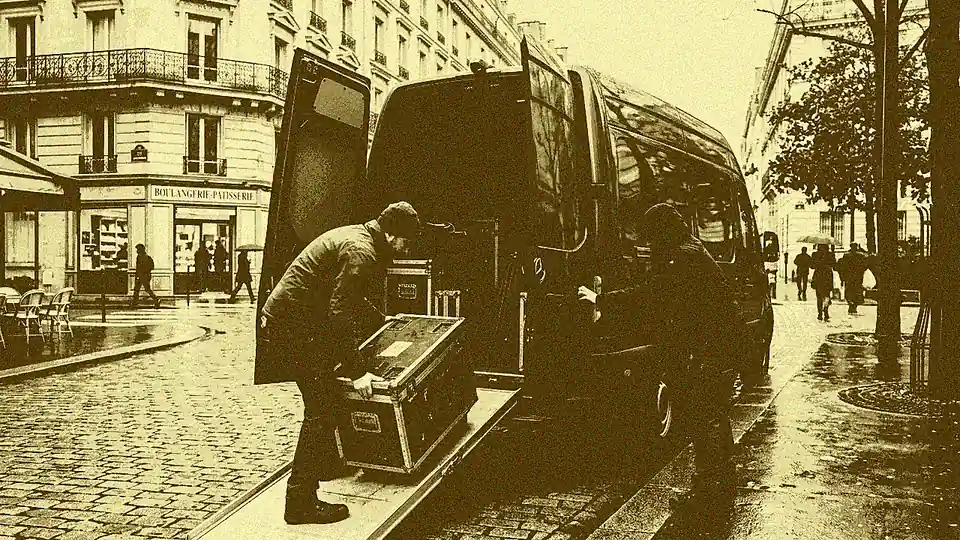
Few sectors depend on transport as intensively as audiovisual production and live events. Crews, talent, equipment and, for events, entire audiences all have to reach a location that changes from project to project. Studies of the audiovisual industry consistently identify transport and energy as the dominant sources of emissions across a production’s life cycle, with fuel for vehicles and generators frequently representing a large share of the total [5]. That makes mobility the first place to look for reductions on almost any shoot or event.
The practical playbook mirrors the corporate one, adapted to the field. On a shoot, that means pooling crew travel, favouring rail for long location moves, prioritising electric or hybrid vehicles for local runs, and consolidating equipment transport to avoid half-empty trucks. For a festival or live event, audience and crew mobility often dominates the footprint, so encouraging public transport, shuttles and car-sharing, and choosing venues with strong transport links, can move the needle more than any on-site measure. The French eco-production methodology promoted by Ecoprod and the CNC treats transport as a core reporting category precisely because of its weight [4]. Coordinating all of this well also depends on the right production tools, so that travel is planned rather than improvised.
GreenPro, the carbon-tracking tool from TheGreenShot, automates data collection for productions and events, turning transport, energy, purchasing and waste data into reports aligned with Albert, the eco-production methodology and the GHG Protocol, with no manual entry. Learn more about GreenPro.
Estimate your company’s carbon footprint
Turning these transport principles into a concrete figure is the quickest way to see where a company’s emissions sit. The free TheGreenShot calculator below estimates a company’s annual footprint across scopes 1, 2 and 3, using official ADEME and EPA emission factors.
Conclusion
The best eco-friendly transportation options for business are rarely exotic: they are rail before flying, electric before combustion, shared before solo, and no trip at all where a call will do. What turns these options into results is a clear policy and reliable measurement, so that every mode choice is visible in the footprint. For transport-heavy sectors such as film, television and events, where moving people and equipment can dominate emissions, the same logic applies with even greater force. As reporting expectations tighten and low-carbon infrastructure spreads, the organisations that treat mobility as a managed, measured system rather than a series of one-off bookings will hold a lasting advantage.
FAQ
What is the most eco-friendly transport option for business travel?
Are electric vehicles genuinely better for a company fleet?
How do business travel emissions fit into carbon accounting?
How can a company reduce transport emissions quickly?
Why is transport so important for film and event footprints?
Going further with TheGreenShot
Cutting transport emissions only works when a company can see them clearly, and that is where measurement becomes the bottleneck for most travel-heavy teams. GreenPro, the carbon-tracking platform from TheGreenShot, turns scattered operational data into certified CO2 reports by automatically categorising transport, energy, materials and waste streams according to recognised methodologies such as Albert, the eco-production reference and the GHG Protocol. It connects natively to production accounting, invoices and budgets, so mobility choices show up in real-time dashboards rather than year-end estimates. For companies and production teams that want to move from good intentions to a managed, auditable travel footprint, it offers a fast, low-effort path to reliable numbers.
Our carbon experts help production studios frame strategy, train teams and track results, tailored to operational constraints.