
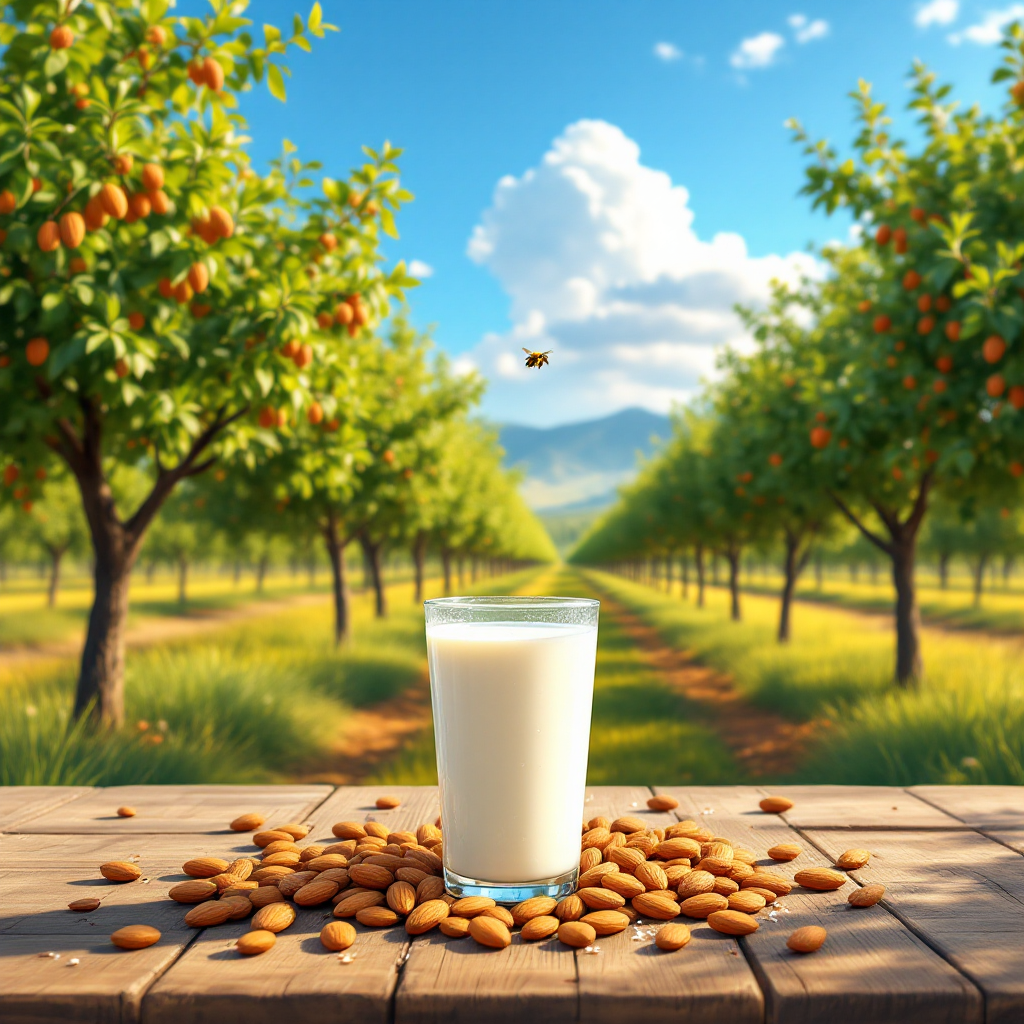
Many people wonder: is almond milk bad for the environment? The answer is more complex than you might think. Producing a single glass of almond milk requires 130 pints of water. Over one-third of commercial bees died during almond pollination last year. The environmental effect of almond milk extends beyond water usage. It includes concerns about pesticides and habitat loss. To understand why almond milk harms the environment, we need to explore these factors in comparison to dairy and other plant-based options. This piece examines the environmental impacts of almond milk and whether sustainable production is achievable.
What Is Almond Milk and Why Is It So Popular?
What is almond milk made from
Almond milk is a plant-based milk substitute manufactured from almonds and water. This creates a beverage with a watery texture and nutty flavor [1]. The production process involves soaking raw almonds in water overnight or up to two days. Manufacturers then grind the soaked almonds with fresh water [2]. The resulting liquid is strained through cheesecloth or a nut milk bag to remove almond meal. This leaves behind a milky white drink like cow’s milk in color and consistency [3].
Commercial almond milk undergoes more processing than homemade versions. Manufacturers roast almonds at temperatures between 95-100°C for about 30 minutes. They then peel, blanch, wet mill, and filter the almonds [3]. The production process has homogenization at 350 MPa and 85°C to increase stability [3]. Many brands contain as little as two percent almonds. This is equivalent to just three to four whole almonds in each 8-ounce glass [4].
The final product contains no cholesterol or lactose and is low in saturated fat [1]. Store-bought versions come in sweetened, unsweetened, vanilla, and chocolate flavors. These are fortified with micronutrients that include calcium, vitamin D, and vitamin B12 [1]. But wide commercial varieties have additives such as gums, thickeners, emulsifiers, and sweeteners. These improve texture and extend shelf life [5].
The rise of almond milk in the US market
Almond milk remained a niche health food item until the early 2000s. Its popularity began to increase at that time [1]. The market experienced explosive growth in 2011. Sales jumped 79% in that year alone [1]. By 2013, almond milk had surpassed soy milk as the most popular plant-based milk in the United States [1].
The growth continued at a remarkable pace. As of 2014, almond milk comprised 60 percent of plant-milk sales and 4.1 percent of total milk sales in the US [1]. By 2021, it had further dominated the market, holding a 77% share of retail milk substitute volume [3]. Sales reached about $1.6 billion, more than twice the sales of oat milk, the second-largest category [6].
Global almond milk sales in 2018 were $5.80 billion, growing at 14% annually. Forecasts predicted a $13.00 billion global market by 2025 [1]. Blue Diamond’s Almond Breeze emerged as the market leader, accounting for just over 36 percent of the almond milk market [6]. The brand achieved 80 percent awareness among milk consumers. This made it the second-most prominent milk-alternative brand after Silk [6].
Why do people choose almond milk
People choose almond milk for multiple reasons, including health, dietary restrictions, and lifestyle choices. Lactose intolerance affects nearly two-thirds of the global population over the age of 10 [7]. This drives many consumers toward plant-based alternatives. Those with dairy allergies, such as hypercholesterolemia, also prefer almond milk as a suitable substitute [4].
The adoption of vegan lifestyles for ethical, environmental, or health reasons has contributed to rising demand for plant-based milk alternatives [4]. Many consumers choose almond milk and believe it offers health benefits. These include its richness in vitamin E and omega-3 fatty acids while remaining low in calories [4]. The product’s versatility appeals to consumers who use it in beverages, frozen desserts, baking, and even personal care products [4].
Breakthroughs in product offerings have sustained market growth. Manufacturers develop new flavors and formulations, including flavored varieties such as vanilla and chocolate. They also create fortified versions containing added vitamins and minerals [4]. Almond milk serves as a key base in dairy-free products like yogurt, cheese, creamers, and frozen desserts. It contributes a creamy texture and neutral taste [3].
Almond Milk Water Usage: The Biggest Environmental Concern
How much water does almond milk require?
Water consumption is the primary environmental concern associated with almond milk production. A single California almond needs an average of 12 liters or 3.2 gallons of water to grow [8]. One liter of almond milk requires about 371 liters of fresh water [9], a figure that varies by almond content across brands.
The water footprint calculation accounts for irrigation water used on trees and the theoretical water required to offset any pollution from production [3]. Store-bought almond milk contains as little as 2% almonds, which translates to three to four whole almonds per 8-ounce glass. This lower almond content reduces the water footprint compared to homemade versions that use much more nuts per serving.
Mature almond orchards need between 36 and 48 inches of water per hectare each year to maintain production levels [4]. In some orchards where trees grow closer together, annual water use reaches 50 to 54 inches [7]. The California almond industry consumes about 4.9 to 5.7 million acre-feet of water per year, equal to the water used by all urban households in the state [10].
California’s drought and almond farming
California produces about 80% of the world’s almonds [10], making the state’s water challenges especially relevant to the global environmental effects of almond milk. The region’s worsening drought threatens the $6 billion almond industry, which has expanded over recent decades. Almond production grew from 370 million pounds in 1995 to a record 3.1 billion pounds in 2020 [10]. That same period saw land planted with almond trees expand from 756 square miles to 2,500 square miles [10].
The drought has drained reservoirs that supply water to Central Valley farms. Shasta Lake stood at only 30% capacity in early August 2021, while Lake Oroville reached just 24% full [10]. State and federal officials reduced agricultural water allocations and forced farmers to leave fields fallow or switch to higher-value crops.
Groundwater depletion in almond-growing regions
Years of drought in central California have forced producers to draw deeper from aquifers to replace limited surface water [9]. More than 80% of almond acreage sits in the San Joaquin Valley, where decades of unchecked pumping created a chronic groundwater deficit averaging nearly 2 million acre-feet per year [4].
Water quality has deteriorated in some areas as groundwater levels decline with pumping. Wells reach deeper into sediment layers with higher salinity and pose threats to productivity. Almond farmers report yield losses exceeding 30 percent from saltier groundwater [9].
Water footprint compared to other crops
Almond milk water usage remains lower than dairy production despite criticism. One liter of dairy milk needs 628 liters of fresh water [9], nearly 70% more than almond milk. California almond farmers reduced water use per almond by 33% between the 1990s and 2010s through the adoption of microirrigation [3]. Over 80% of California almond farms now use microirrigation, nearly double the rate of California farms overall [3].
Other Environmental Impacts of Almond Milk
Pesticide use and bee deaths
Almond production creates severe threats to pollinator health that go way beyond water concerns. Colony losses reached 55% in 2023-2024. This is the highest decline documented to date [3]. Winter 2018-19 proved devastating, with 50 billion bees dying within a few months. This represented more than one-third of commercial US bee colonies [11].
Pesticides emerge as the main culprit. Almond crops receive 35 million pounds of pesticides annually. This is more than any other crop in absolute quantities [11]. Glyphosate has been shown to be lethal to bees, and large-scale growers apply it widely [11]. Research from Ohio State University revealed that combinations of insecticides and fungicides transform into lethal cocktails when mixed in almond groves. These combinations are safe when used alone. These combinations decreased larval survival by more than 60 percent in extreme cases [12].
Declining bee health affects the economy. Hive rental costs jumped from $50 in 2003 to $200-220 currently [3]. Bee theft has escalated, with about 10,000 hives stolen since 2013. This totals over $3.5 million in losses [3]. Beekeepers consider 18-23% annual colony losses acceptable, but actual mortality rates far exceed this threshold [3].
Land use and habitat loss
Almond orchard expansion has altered California’s agricultural landscape. The rapid spread of tree horticulture throughout northwestern regions has filled in former cropping land bounded by roadside vegetation networks [3]. This transformation eliminates habitat for native pollinators, which occur only in small numbers in conventional orchards with minimal ground cover [3].
Eutrophication and water pollution
Groundwater quality is threatened by agricultural runoff. Contaminants, including salts, herbicides, and nitrates, appear frequently in Central Valley aquifers [7]. The Department of Pesticide Regulation expanded groundwater protection areas in 2004 and added compounds used in almond production to monitoring lists [7].
The industry has improved nitrogen management practices despite these concerns. Almond growers achieve nitrogen use efficiency of 75-85%. This compares to typical rates of 50% or less in other crops [13]. This efficiency makes almonds among the most responsible nitrogen-using agricultural products.
Carbon emissions from almond production
Nutrient management is the largest single contributor to greenhouse gas emissions, accounting for about 32% of total CO2-equivalent emissions [14]. Harvest, pollination, and irrigation operations contribute another 61% due to their energy-intensive nature [14].
Almonds produce less than 1 kilogram of carbon emissions per kilogram of product [15]. Almond orchards capture and store carbon both above and below ground over their 25-year lifecycle. Coproducts offset over 50% of production emissions [16]. This positions almonds favorably against beef (20+ kg CO2-eq), cheese (10+ kg), and even beans and vegetables (around 2 kg) [15].
Is Almond Milk Worse for the Environment Than Dairy?
Greenhouse gas emissions comparison
Dairy milk produces about three times more greenhouse gas emissions than almond milk [10]. Oxford researchers calculated that emissions per cup of cow’s milk are 0.6 kilograms [17], while almond milk generates just 0.7 kg of carbon dioxide equivalent [9]. This difference stems from methane released through cow burps and digestive processes. Methane has 80 times the warming power of carbon dioxide [17], and the world’s 1.5 billion cows contribute significantly to climate change.
Cattle ranching drives 80% of deforestation in the Amazon rainforest and releases 340 million tons of carbon dioxide each year [17]. This represents 3.4% of global greenhouse gas emissions. Plant-based milks produce about one-third or less of dairy’s emissions [4].
Water consumption: almond vs dairy
Despite criticism of almond milk’s water usage, dairy production needs much more water on a global scale. Producing one liter of dairy milk takes 628 liters of water [18][19], compared to 370 liters for almond milk [19]. Cow’s milk uses two to twenty times as much freshwater as plant-based alternatives [10].
But the water impact varies by region. Almond milk produced in water-stressed California may have worse localized effects than dairy milk from regions with less water scarcity [4]. California produces the most cow’s milk in the United States, which makes direct comparisons valid in many cases [4].
Land use requirements
Dairy operations require about 10 times as much land as almond milk production [10]. Producing a glass of dairy milk takes nine times more land than almond or oat milk [9]. Dairy cows graze 830 million hectares worldwide, an area equivalent to Brazil’s size [9]. Almond orchards have lower land requirements per liter, even when you factor in grazing and crop acreage [19].
Overall environmental footprint
Cow’s milk produces much higher impacts than plant-based alternatives in every way [10]. It creates higher eutrophication levels, among other issues, like greater emissions and land use. Rice and almond milk show 50% lower carbon emissions and 90% lower land use compared to dairy for calorie production [20]. Switching to plant-based alternatives reduces your dietary environmental footprint [10], though the sustainability of almond milk depends on addressing water management in California’s agricultural regions.
Better Plant-Based Milk Alternatives for the Environment
Oat milk: the sustainable winner
Oat milk has the lowest environmental impact among plant-based alternatives. Production generates 0.9kg CO2 per liter [8], a 72% decrease compared to dairy’s 3.2kg [8]. Water consumption drops to just 48 liters per liter of milk [8][21]. That’s a 92% reduction from dairy’s 628 liters [8]. Land requirements fall by 91% and use only 0.8 square meters per liter, compared with dairy’s 9 square meters [8].
Oats require less water than other crops. They perform well on multiple environmental metrics [10]. Studies show oat milk scores as well as or better than both organic and conventional cow’s milk on 12 environmental impacts. These include acidification, eutrophication, and ecosystem damage [11]. But glyphosate contamination poses concerns. Farmers spray the herbicide on crops before harvest [12]. Oatly addresses this by sourcing from suppliers that prohibit glyphosate use, though their oats aren’t certified organic [12].
Soy milk: balanced nutrition and low impact
Soy milk requires only 28 liters of water to produce 1 liter [3]. This makes it one of the most water-efficient options. The protein content nearly matches that of cow’s milk and contains all essential amino acids [21]. Greenhouse gas emissions are 62-78% lower than dairy levels [11].
Concerns about Amazon deforestation miss the mark. About 95% of Brazilian soy goes to animal feed, not human consumption [10]. Most soy for plant milk comes from Europe, North America, and China [22]. European regulations restrict the use of genetically modified soy in direct human food. EU yields match or exceed South American production at 3-4 tons per hectare [10].
Hemp and pea milk options
Hemp plants offer multiple environmental advantages. The crop requires few pesticides due to natural disease resistance. It creates weed-suppressing shade [3]. Deep roots improve soil structure and reduce the presence of fungi [3]. Hemp ranks among the top five of 16 common crops for sustainability in terms of pesticide use, soil erosion, and water consumption [12].
Pea milk emerges as another strong contender. The total water footprint is 86% lower than that of dairy [4]. The protein content rivals that of cow’s milk while producing minimal emissions, comparable to oat and soy varieties [23][24].
Coconut milk considerations
Coconut milk generates 1.1 to 2.5 kg CO2-equivalent per liter [25]. This represents 50-75% lower emissions than dairy [25]. Trees absorb carbon and use much less water than dairy cows [3]. But production remains very land-intensive and drives deforestation in tropical regions [23][13]. Labor practices raise ethical concerns. Coconut pickers in some countries earn less than a dollar daily [3].
How to choose the most sustainable option
Selecting environmentally responsible milk requires dissecting multiple factors:
- Source organic varieties to reduce chemical fertilizers, pesticides, and soil pressure [3]
- Think about packaging materials. They represent 45% of greenhouse gas emissions in almond milk production [3]
- Minimize waste. Discarded milk means wasted resources from production [3]
- Broaden choices to prevent market overexploitation of single crops [3]
Conclusion
The question of whether almond milk harms the environment doesn’t have a simple answer. Of course, its water consumption in drought-stricken California raises concerns, especially given groundwater depletion and bee colony losses. Then again, almond milk still produces substantially fewer emissions and requires less water than dairy milk when you compare them.
Those seeking the most sustainable choice will find that oat milk and soy milk deliver better environmental performance across nearly all metrics. Think about factors beyond just one environmental impact before you make your selection. Assess water usage and carbon emissions, as well as land requirements. Vary your choices rather than relying on a single alternative, and always opt for organic varieties when possible.
FAQs
Q1. Is almond milk worse for the environment than dairy milk? No, almond milk is significantly better for the environment than dairy milk. While almond milk requires about 371 liters of water per liter produced, dairy milk needs 628 liters—nearly 70% more. Dairy also produces approximately three times as many greenhouse gas emissions and requires ten times as much land as almond milk production.
Q2. What is the most environmentally friendly plant-based milk alternative? Oat milk is considered the most sustainable plant-based milk option. It uses only 48 liters of water per liter produced (compared to 371 for almond milk), generates lower carbon emissions at 0.9kg CO2 per liter, and requires 91% less land than dairy milk. Soy milk is another excellent choice with a similarly low environmental impact.
Q3. Why is almond milk criticized for its environmental impact? Almond milk faces criticism primarily because of its high water use in drought-stricken California, where 80% of the world’s almonds are grown. Additionally, almond production has been linked to significant bee colony losses—over 50 billion bees died during pollination in 2018-19—due to pesticide exposure and the stress of commercial pollination practices.
Q4. How much water does it take to produce almond milk? Producing one liter of almond milk requires approximately 371 liters of fresh water. A single almond needs about 3.2 gallons (12 liters) of water to grow. However, this is still considerably less than dairy milk, which requires 628 liters of water to produce 1 liter.
Q5. Are there better alternatives to almond milk for vegans concerned about sustainability? Yes, several alternatives offer better sustainability profiles. Oat milk uses the least water and has the lowest carbon footprint. Soy milk provides excellent nutrition with minimal environmental impact and uses only 28 liters of water per liter. Hemp and pea milk are also sustainable options with low water requirements and minimal pesticide needs.
Our carbon experts help production studios frame strategy, train teams and track results — tailored to operational constraints.