
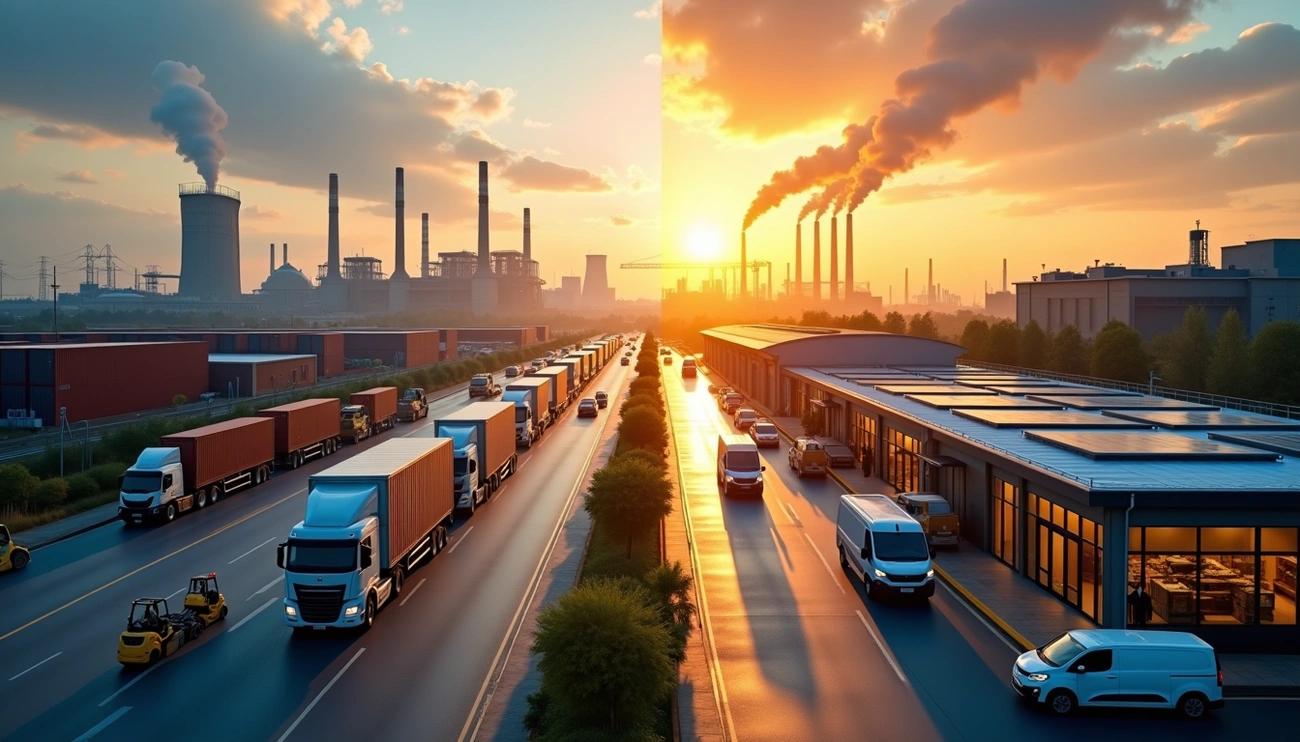
Scope 3 emissions, also known as value chain emissions, make up about 90% of an average company’s total climate impact.
Companies need to grasp the difference between upstream and downstream supply chains to manage emissions well. Value chain emissions account for the largest share of most companies’ carbon footprint. These emissions prove harder to track and reduce. The supply chain splits into two parts: upstream emissions occur before products reach a company, and downstream emissions occur after products leave a company’s control. The World Resources Institute has defined 15 different categories of Scope 3 emissions across upstream and downstream activities.
This detailed guide explores how upstream and downstream emissions differ, what makes them challenging, and ways to measure and reduce them effectively. Companies that work to minimize emissions see substantial financial rewards. A BCG survey found that 40% of companies achieved annual benefits of $100 million or more. Readers of this piece will learn ways to handle both aspects of their supply chain and enhance their sustainability reporting and performance.
Understanding Scope 3 and Its Role in Emissions Reporting
Scope 3 emissions make up the most significant but hard-to-manage category of greenhouse gas emissions that organizations don’t handle well. These emissions extend beyond what a company can directly control and encompass the environmental impacts across the entire value chain.
Definition of Scope 3 Emissions
Scope 3 emissions include all indirect emissions that happen in a company’s value chain but are not under the organization’s direct control. The Greenhouse Gas Protocol states that these emissions cover both upstream and downstream activities [1]. Upstream emissions come from bought or acquired goods and services, while downstream emissions are linked to sold goods and services [1]. The GHG Protocol divides Scope 3 emissions into 15 categories across the upstream and downstream supply chains. These categories don’t overlap to avoid counting emissions twice [1].
Many organizations identify their most significant emission sources in supply chain categories (bought goods and services) and in how their products are used. PwC points out that “For many companies, categories 1 and 11, which are those related to your supply chain and use of your products, are the most significant” [2]. Companies need to consider their role as both suppliers to customers and customers to their suppliers when tackling these emissions [2].
Why Scope 3 Accounts for 90% of Emissions
Modern supply chains and product lifecycles are complex and widespread. That’s why Scope 3 accounts for the majority of overall emissions. McKinsey’s research shows that Scope 3 emissions account for about 90% of a company’s total emissions [3]. The average global company has upstream Scope 3 emissions that are 11.4 times higher than its operational emissions [1].
Most emissions come from outside company walls—in raw material production, transportation, and product use [4]. Kraft Foods found that its value chain emissions make up more than 90% of its total emissions [5]. Yale University’s Scope 3 emissions were about 57% of its total footprint in 2022 [5].
Scope 3 vs Scope 1 and 2: Key Differences
Each scope has its own level of ownership and control:
-
Scope 1 emissions come directly from sources a company owns or controls, such as on-site fuel combustion and company vehicles [6].
-
Scope 2 emissions are indirect emissions from bought electricity, steam, heating, and cooling [6].
-
Scope 3 emissions cover all other indirect emissions throughout the value chain, both upstream and downstream [6].
The main difference lies in the level of control companies have. They directly control Scope 1 emissions and have a good influence over Scope 2, but only an indirect influence over Scope 3 [1]. Scope 3 presents unique challenges—companies struggle to track these emissions due to complex supplier relationships and widespread business activities [7].
Measuring Scope 3 emissions brings significant benefits. Organizations can identify emission hotspots across their value chains, assess supplier performance, make better purchasing decisions, drive product innovation, and strengthen their climate strategy [6]. On top of that, it gives companies a chance to reduce greenhouse gas emissions, since these emissions make up such a large share of total emissions [1].
As rules like the EU Corporate Sustainability Reporting Directive change, Scope 3 emissions data helps create value and business insights [4]. Companies can take meaningful action by focusing on roughly accurate estimates rather than perfect data, even though measurement is challenging [1].
Breaking Down Upstream Emissions in the Supply Chain
Upstream emissions make up a crucial part of an organization’s Scope 3 inventory before products reach company operations. Consumer goods companies estimate these emissions account for two-thirds of their Scope 3 emissions [8].
Purchased Goods and Services Emissions
Purchased goods and services emissions cover all cradle-to-gate emissions from products that companies buy [9]. Many organizations, especially in the retail and manufacturing sectors, find that this category is their most significant source of emissions.
Companies can measure these emissions through four key methods [9]:
-
Supplier-specific method – collecting product-level data directly from suppliers
-
Hybrid method – combining supplier data with secondary data
-
Average-data method – using mass or units purchased with emission factors
-
Spend-based method – calculating based on the economic value of purchases
Companies usually start with a screening assessment using tools such as the GHG Protocol’s Scope 3 Evaluator to identify “hot spots” before developing detailed inventory methods [10].
Capital Goods and Fuel-Related Activities
Capital goods emissions result from the production of long-term assets such as equipment, machinery, buildings, and vehicles [6]. These items appear as fixed assets or plant, property, and equipment (PP&E) in financial accounting, unlike operational purchases [6].
Companies should report the total cradle-to-gate emissions of purchased capital goods at the time of acquisition rather than spreading them over time [6]. This approach can lead to significant variations in emissions during years with major capital purchases.
Upstream Transportation and Distribution
This category includes emissions from the transportation and distribution of products between tier 1 suppliers and company operations, as well as third-party transportation services [5]. Sources range from air, rail, road, and marine transport to storage of purchased products [5].
Companies can use three primary calculation methods [5]:
-
Fuel-based method (using actual fuel consumption)
-
Distance-based method (using mass, distance, and mode)
-
Spend-based method (using financial expenditure)
These emissions reflect transportation companies’ scope 1 and 2 emissions, allocated to the reporting company [5].
Business Travel and Employee Commuting
Business travel emissions come from employee transportation in third-party vehicles for business activities [11]. Employee commuting covers travel between homes and worksites [12].
Companies track distances traveled by different transport modes for business travel [11]. Annual surveys help collect data on employees’ commuting habits, including distance, frequency, and mode of transport [12].
Waste Generated in Operations
Third-party disposal and treatment of waste from company operations generate these emissions [1]. Both solid waste and wastewater disposal can be achieved through landfilling, incineration, composting, or recycling [1].
Different waste types release various greenhouse gases, mainly CO₂, CH₄, and HFCs [1]. Most companies calculate these emissions using waste-type-specific or average data methods [1].
Upstream Leased Assets
Upstream leased assets cover emissions from operating assets that companies lease but haven’t included in scope 1 or 2 inventories [13]. This applies only to companies that operate leased assets (lessees) [13].
The organizational boundary approach determines categorization—leased assets might already appear in scope 1 and 2 emissions under operational control, while under financial control, they would fall under scope 3 [14].
Data collection challenges exist across all upstream categories. Companies should focus on directional accuracy to effectively reduce their supply chain emissions.
Exploring Downstream Emissions and Their Impact
Downstream emissions show the climate effects after products leave company operations and move through distribution, use, and end-of-life phases. These emissions make up much of an organization’s total carbon footprint.
Use of Sold Products and End-of-Life Treatment
Waste disposal and product processing after consumer use generate end-of-life treatment emissions. Category 12 tracks total expected emissions from all products sold during the reporting year [15]. Companies need to make assumptions about consumer disposal behaviors and estimate:
-
Waste treatment ratios across landfilling, incineration, or recycling
-
Regional differences in waste management systems
-
Material composition and breakdown processes
Companies must gather data on the total mass of sold products and packaging from the point of sale through end-of-life [15]. This category is essential in packaging-heavy sectors such as electronics, appliances, and consumer goods [16].
Downstream Transportation and Distribution
Category 9 has emissions from transportation and distribution of sold products in vehicles and facilities not owned by the reporting company [3]. This covers transportation after the point of sale, unlike Category 4 (upstream transit).
Companies can use fuel-based, distance-based, or spend-based calculation methods, but struggle to get accurate data from downstream partners [3]. Companies can estimate using government publications, online maps, or port-to-port travel distances when exact transportation distances aren’t known [3].
Processing of Sold Products
Category 10 has emissions from third parties processing intermediate products before final use [17]. These products need further transformation or integration into another product, which would create additional emissions.
Two main calculation approaches exist:
-
Site-specific method using actual fuel and electricity consumption data
-
Average-data method using industry standards when specific data isn’t available
Emissions should be allocated proportionally when downstream processes use multiple inputs beyond those sold by the reporting company [17].
Franchises and Investments
Franchise emissions (Category 14) track operations of franchises not counted in Scope 1 or 2. This applies to franchisors whose brand serves independently operated locations [18]. Companies can collect specific franchise data or use average statistics based on building type and floor space [18].
Downstream Leased Assets
Category 13 tracks emissions from assets the reporting company owns but leases to others [19]. This differs from upstream leased assets, where the company retains ownership while another entity operates the asset.
Companies should divide emissions based on facility usage when calculating these numbers [19]. Some organizations might treat leased products as sold products to avoid double-counting emissions across categories [19].
Upstream vs Downstream Supply Chain: Key Differences
A key difference between upstream and downstream supply chain sectors lies in their stakeholders, lifecycle phases, and control mechanisms. These factors shape how companies manage their indirect emissions.
Who Pays: Company vs Consumer
Money flow creates the most apparent divide between upstream and downstream emissions. Upstream emissions come from goods and services that reporting companies buy before receiving them [2]. Downstream emissions stem from products and services that customers buy from the company [7]. This financial boundary makes categorization simple – if the company pays, it’s upstream; if customers pay, it’s downstream [4].
Lifecycle Phase: Pre-Production vs Post-Sale
Product lifecycle shows that upstream emissions happen during pre-production – from extracting raw materials through manufacturing before reaching company operations [20]. Downstream emissions occur after sales during distribution, product use, and disposal [20]. Research shows pre- and post-production processes now dominate greenhouse gas emissions globally. These emissions have doubled since 1990, reaching 5.8 Gt CO₂ eq. yr⁻¹ by 2019 [21]. Food supply chains became the most significant agri-food system component by 2019 in China (1100 Mt CO₂eq. yr⁻¹), the USA (700 Mt CO₂eq. yr⁻¹), and the EU-27 (600 Mt CO₂eq. yr⁻¹) [22].
Data Collection Challenges in Each Phase
Companies need to work with suppliers and internal teams, such as procurement, energy, manufacturing, and logistics, to collect upstream emissions data [2]. Well-managed supply chains can make upstream data collection relatively straightforward [4]. Downstream emissions pose unique challenges because they depend on consumer behavior and waste-disposal practices beyond the company’s control [4]. Organizations don’t handle tracking these emissions well due to varying product use patterns and end-of-life treatment options [10].
Control and Influence Over Emissions
Companies have different levels of influence over upstream and downstream emissions, though both exist outside direct control. Supplier engagement, procurement choices, and design specifications help companies affect upstream emissions [8]. Consumer behavior drives downstream emissions, making them harder to influence [4]. Many corporations can choose eco-friendly production methods for upstream processes, but face bigger challenges when addressing consumer-driven downstream impacts [23].
How to Measure and Reduce Scope 3 Emissions
A successful scope three emissions reduction strategy needs proper measurement as its foundation. Most companies start their trip with a screening assessment. This helps them identify priority areas before they develop detailed inventory methods.
Spend-Based vs Activity-Based Data Collection
Companies use two primary methods to measure scope three emissions. The spend-based method turns financial expenditure into emissions using industry-average emission factors [24]. This approach gives a quick baseline when detailed data isn’t available, though it’s not as precise [24]. The activity-based method uses operational data, such as fuel and electricity usage, to obtain more accurate emissions estimates [24]. Most companies combine both approaches—they use activity-based data where possible and fill gaps with spend-based methods [25].
Using Carbon Accounting Software
Carbon accounting software makes it easier to measure scope three emissions. Good platforms give complete coverage of all 15 scope three categories. They include supplier tools, user-friendly dashboards, and up-to-the-minute data analysis [26]. These platforms connect with existing business systems and automatically collect data while detecting errors [27]. Such tools help solve a big problem—only 9% of organizations can calculate their total emissions [28].
Supplier and Customer Engagement Strategies
Companies should rank suppliers based on their emission contribution [9]. Initial evaluations indicate that top suppliers account for 80% of emissions [29]. Good communication is essential—companies must explain why the program matters, set clear expectations, and follow up regularly [29]. Successful programs include supplier training, consistent check-ins, and clear consequences if suppliers don’t participate [29].
Science-Based Targets for Emission Reduction
Science-Based Targets initiative (SBTi) requires companies with high scope three emissions to include them in their reduction goals. Near-term targets must cover at least 67% of total scope three emissions [30]. Companies can choose absolute reduction targets, intensity reduction targets, or supplier engagement targets [9]. Supplier engagement targets need to be completed within 5 years. Suppliers must set their own science-based scope 1 and 2 targets at a minimum [9].
Conclusion
The difference between upstream and downstream supply chain emissions helps companies target their most significant climate effects. Our research shows that value chain emissions make up 90% of organizational carbon footprints. These numbers make them key targets in detailed sustainability strategies.
Upstream emissions occur before products reach company operations. They present better opportunities through supplier engagement and procurement choices. Downstream emissions pose different challenges because consumer behavior varies widely. Yet they remain vital parts of complete emissions reporting.
The GHG Protocol’s 15 categories provide companies with a well-defined framework for addressing both supply chain aspects. Innovative organizations start by conducting screening assessments to identify emission hotspots, then develop detailed inventory methods. Carbon accounting software makes this complex process easier and improves how companies work with suppliers and customers.
Companies can save money by cutting emissions. Many report yearly returns of over $100 million – this is a big deal, as it shows the financial value. Science-based targets chart a reliable path forward, especially when at least 67% of total Scope 3 emissions are covered, as required by initiatives like the SBTi.
Success depends on finding the right balance between data precision and practical action. Companies should focus on directionally accurate assessments that drive real progress instead of perfect measurements. Corporate sustainability’s future needs this comprehensive view – one that sees both upstream and downstream effects while steadily reducing emissions across the value chain.
Key Takeaways
Understanding upstream vs. downstream supply chain emissions is critical for effective climate action, as these value chain emissions account for 90% of most companies’ total carbon footprint.
• Scope 3 emissions dominate corporate footprints – Value chain emissions account for approximately 90% of total emissions, making upstream and downstream measurement essential for meaningful climate action.
• Upstream emissions offer more control opportunities – Companies can influence supplier choices and procurement decisions more easily than downstream consumer behavior and product end-of-life treatment.
• Start with screening assessments to identify hotspots – Use spend-based methods initially to pinpoint the most significant emission sources before investing in detailed activity-based data collection.
• Supplier engagement drives measurable results – Focus on top suppliers representing 80% of emissions, provide clear expectations, and establish science-based targets requiring supplier participation.
• Financial benefits accompany emission reductions – 40% of companies report annual benefits exceeding $100 million from active emissions reduction programs, proving sustainability drives profitability.
The key to success lies in taking action with directionally accurate data rather than waiting for perfect measurements, enabling companies to reduce emissions across their entire value chain systematically.
FAQs
Q1. What are the main differences between upstream and downstream emissions in the supply chain? Upstream emissions occur before products reach a company, involving the production and transportation of purchased goods. Downstream emissions occur after products leave the company’s control, including during distribution, use, and disposal. Upstream emissions are often easier to influence through supplier choices, while downstream emissions depend more on consumer behavior.
Q2. Why are Scope 3 emissions considered so significant for companies? Scope 3 emissions, which include both upstream and downstream activities, typically account for about 90% of a company’s total carbon footprint. They represent the most extensive yet challenging category of greenhouse gas emissions, encompassing the environmental impact of the entire value chain beyond direct company control.
Q3. How can companies effectively measure their Scope 3 emissions? Companies can start with a screening assessment using spend-based methods to identify emission hotspots. They can then progress to more detailed activity-based data collection for priority areas. Carbon accounting software can streamline this process by providing comprehensive coverage of all 15 Scope 3 categories and facilitating supplier engagement.
Q4. What strategies can businesses use to reduce their upstream emissions? To reduce upstream emissions, companies can prioritize supplier selection based on their emission contributions, engage with top suppliers that account for about 80% of emissions, and implement supplier training programs. Setting clear expectations, establishing follow-up mechanisms, and requiring suppliers to set their own science-based targets are also effective strategies.
Q5. Are there financial benefits to reducing Scope 3 emissions? Yes, many companies report substantial financial benefits from active emissions reduction programs. According to a survey, 40% of respondents reported annual benefits of at least $100 million from their efforts to reduce emissions, demonstrating that sustainability initiatives can drive profitability.
Our carbon experts help production studios frame strategy, train teams and track results — tailored to operational constraints.